
Spreading biodiversity in the city, an opportunity for residents to reclaim the street in a different Way
Solferino street - Lille - France
Study Year 2022 - 2023 / Master's Degree (Year 2)
Final Year Project
Duration: Full Year
Workshop: FAIR-E, Dimitri Fache & Olivier Camus
Supervisor: Gilles Debrun
Experts: Solène Croci & Morgane Flégeau
How to successfully combine biodiversity and appropriation in the open spaces of the city to make it more sustainable, desirable, and enjoyable?

Plan of Solférino Street

Crossing the city from end to end, Solférino Street is one of the major axes of Lille. Its 2 kilometers length encompasses different programs: a residential area, a student area, and a festive area, which gives the street a nearly national radiance.
Solférino connects two major biodiversity spots in Lille, namely the Citadelle Park and the Saint-Sauveur wasteland. Each of these spots contains a multitude of plant and animal species. However, the expansion of these species is limited due to the high impermeability of the city’s soils. In terms of impermeable surfaces, Solférino Street is no longer noticeable and blends into this gray mass of impermeable soils.
Interviews with residents, shopkeepers, passersby, and research on the rest of the biodiversity show the need for a calming of the street and a certain willingness to work for cohabitation. Indeed, at present, the street contains few vegetation spaces. Most residents lack an outdoor space, and species do not really manage to establish themselves in this unfriendly street. Passersby, meanwhile, have little circulation space, as it is mostly given to vehicles and parking. This disproportion leads them to walk along the facades, creating a lack of privacy for the residents.
The project aims to make changes, more or less significant, to allow all street actors to create a space that respects everyone’s needs. Transforming the street into an ecological corridor means removing the curtains behind which the residents hide, rebalancing the pathways, and offering new circulation possibilities for species. A table, depicting the various components of the street, has been developed to show the different possible action levers, varying according to the desired level of ecological corridor.
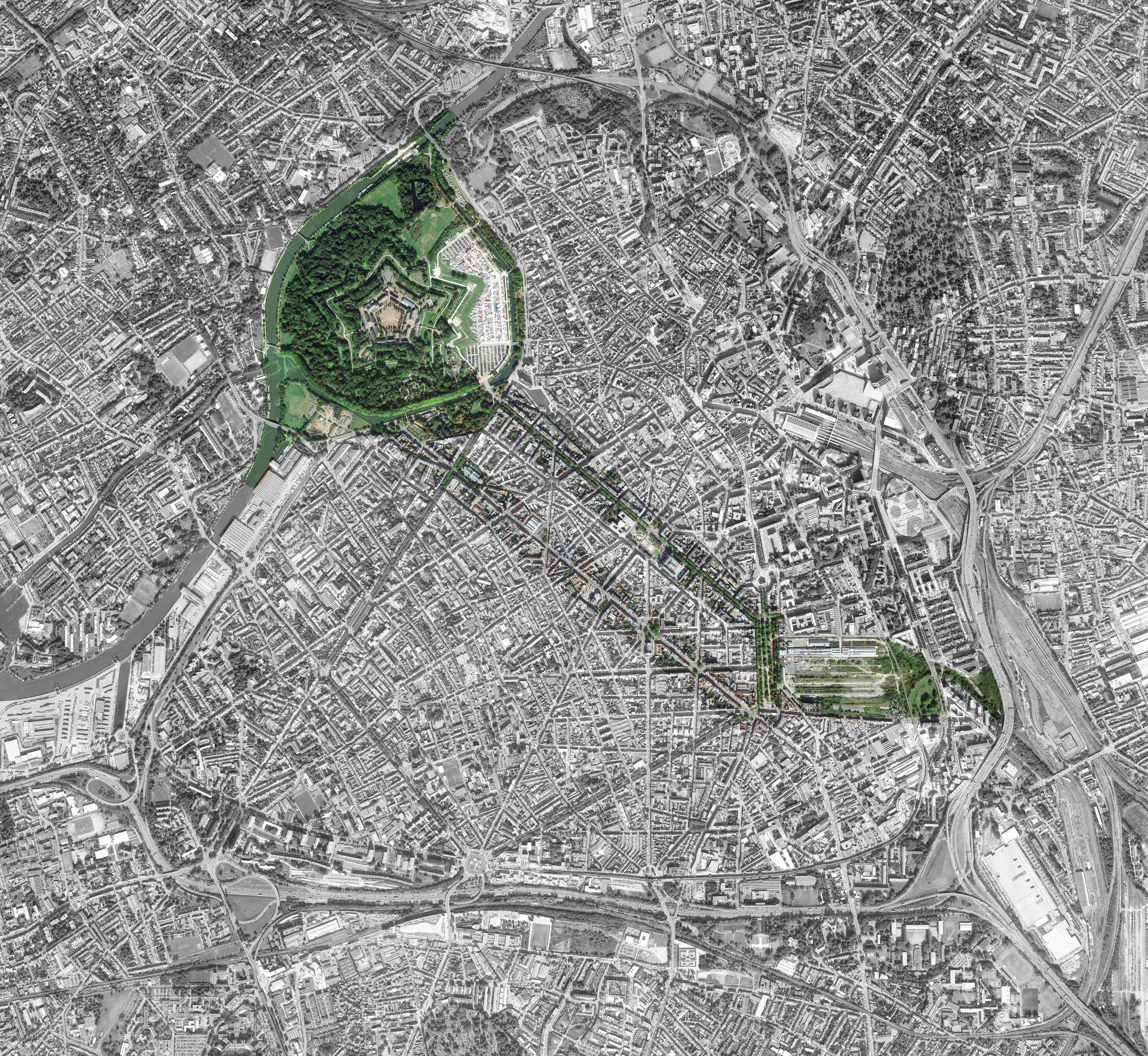
Map of the Spontaneous Green Network, Denis Delbaere, 2021
Solférino Street: A Potential Ecological Corridor
Solferino street today

Solférino Street Today
In 5 years, Solférino Street
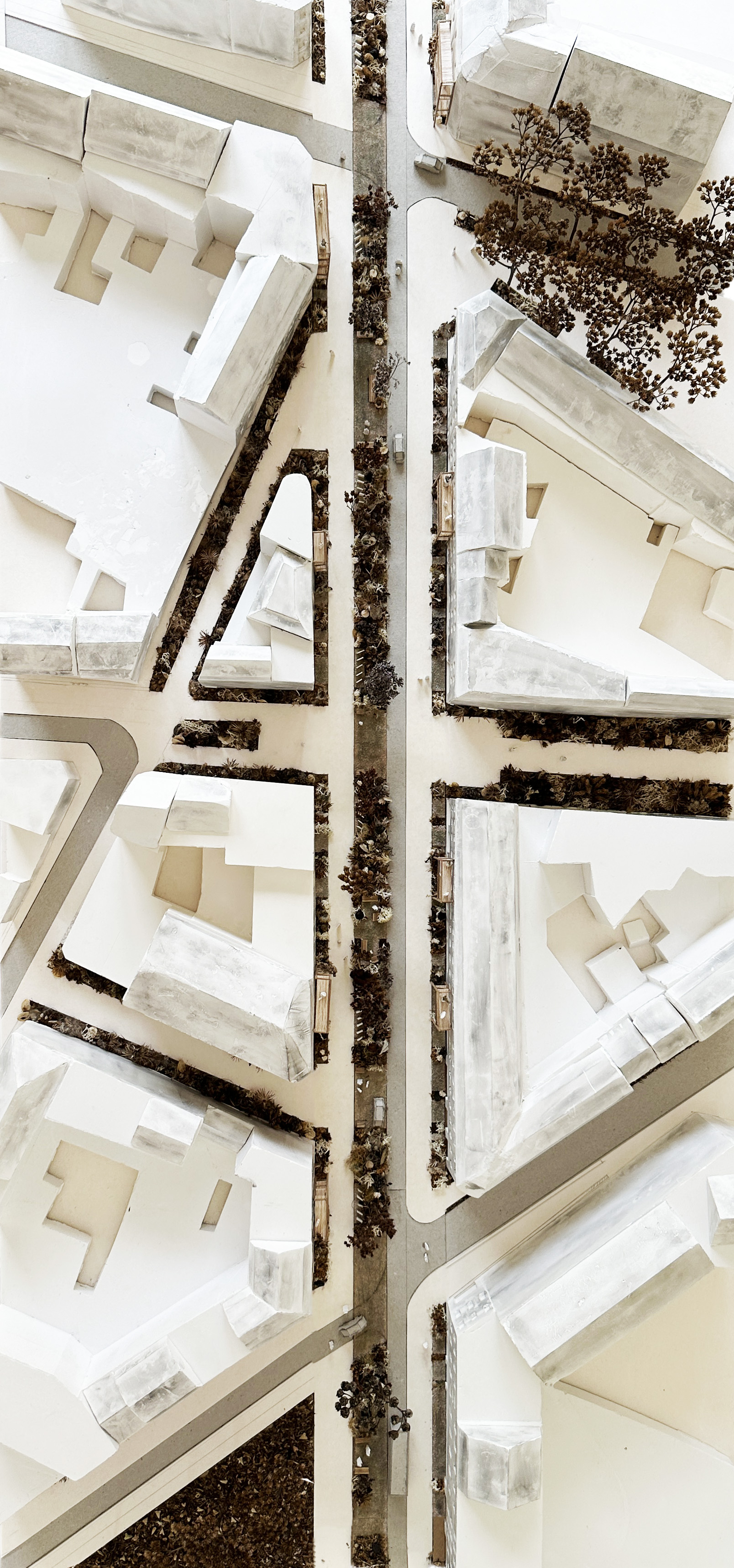
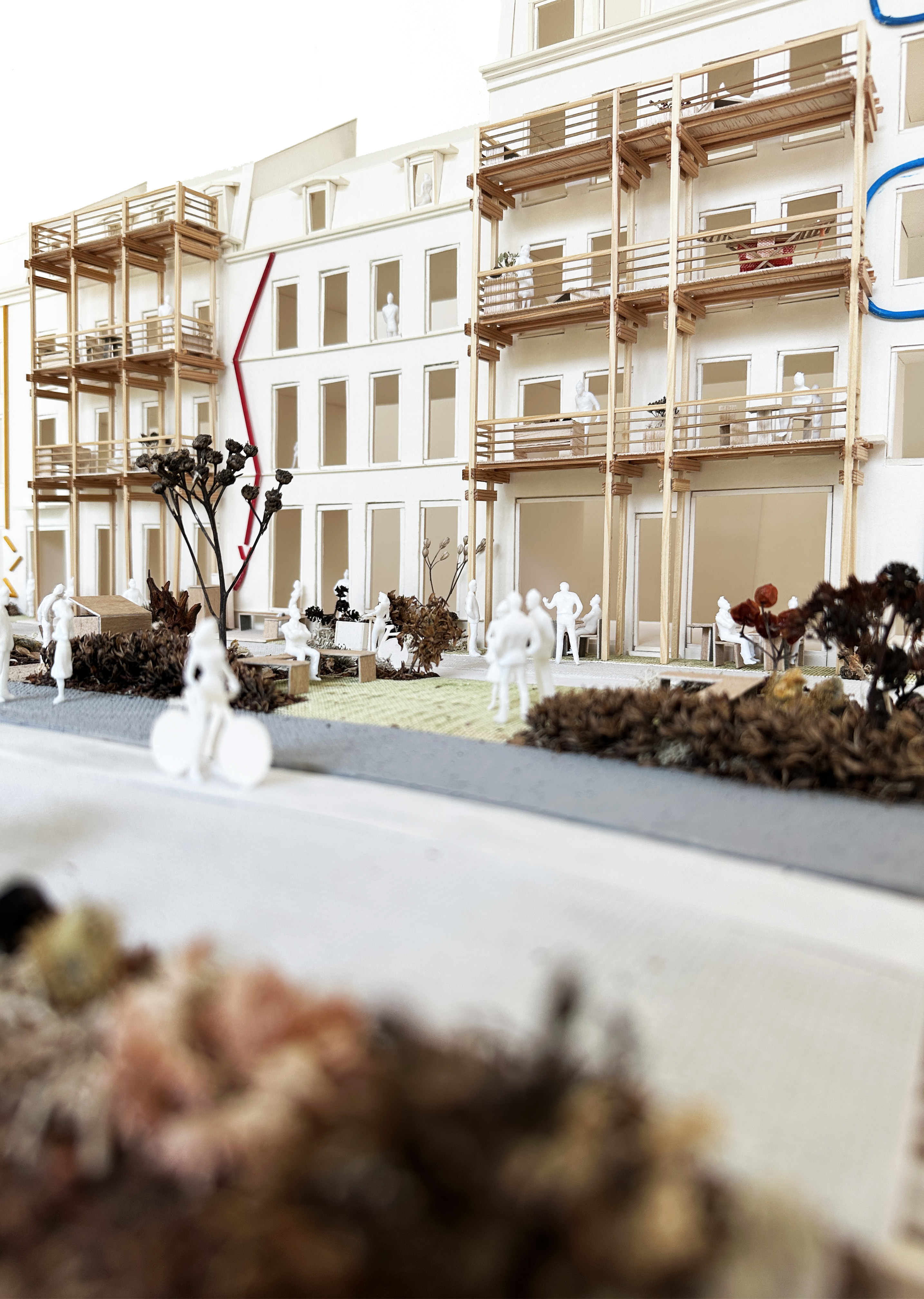
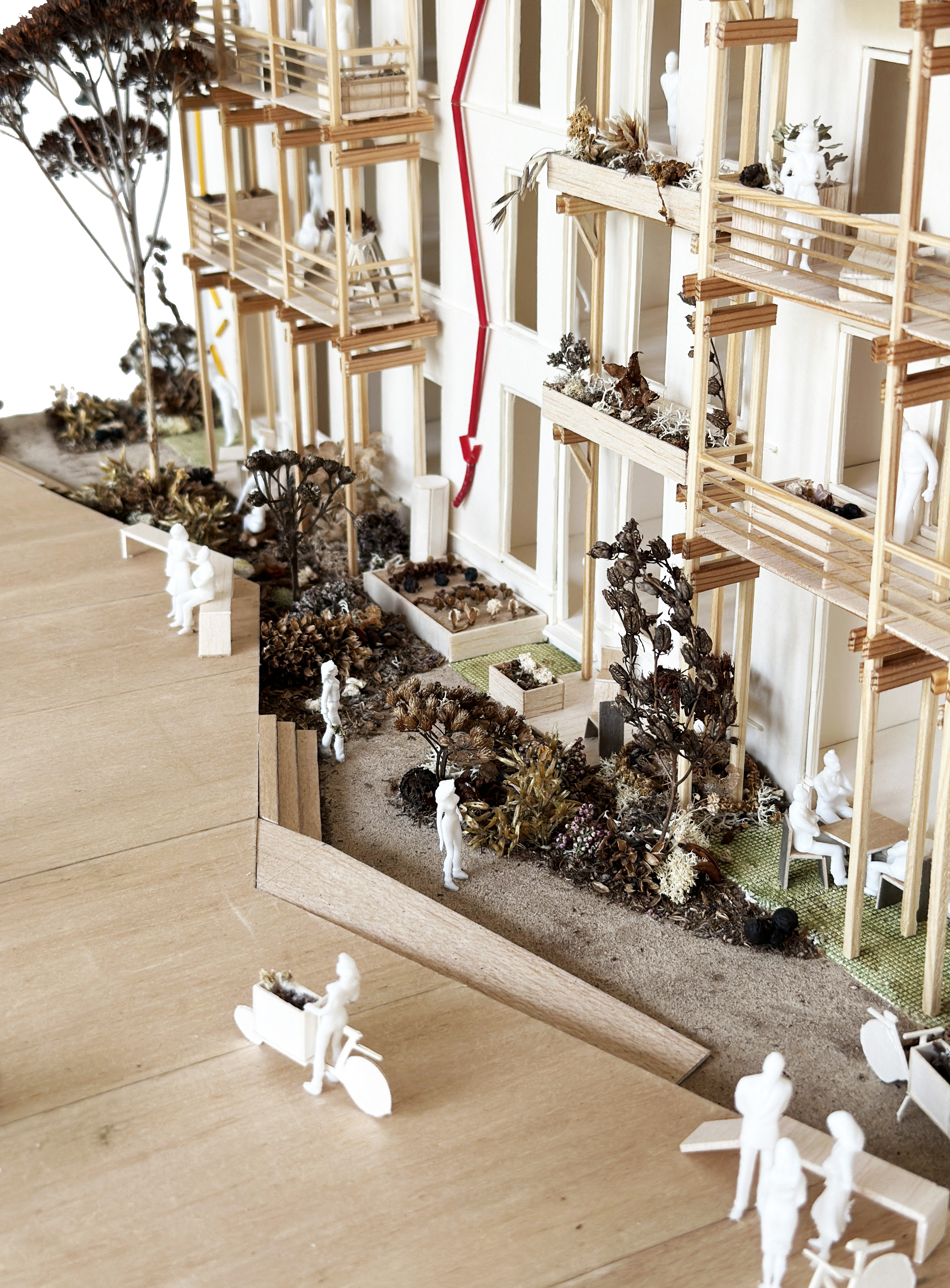
Scale model 1:200 of a section of the street with the moderate level
The level of moderate ecological corridor tends to focus more on rebalancing the width of the street. To do this, one of the road traffic lanes is repurposed to be transformed into a green space, dedicated to biodiversity. The idea is to create a shared space for motor vehicles, pedestrians, and users of soft mobility. The parking spots, which currently line the roads, will be replaced by biodiversity spaces. However, some will remain as short-term parking to facilitate deliveries for local businesses.
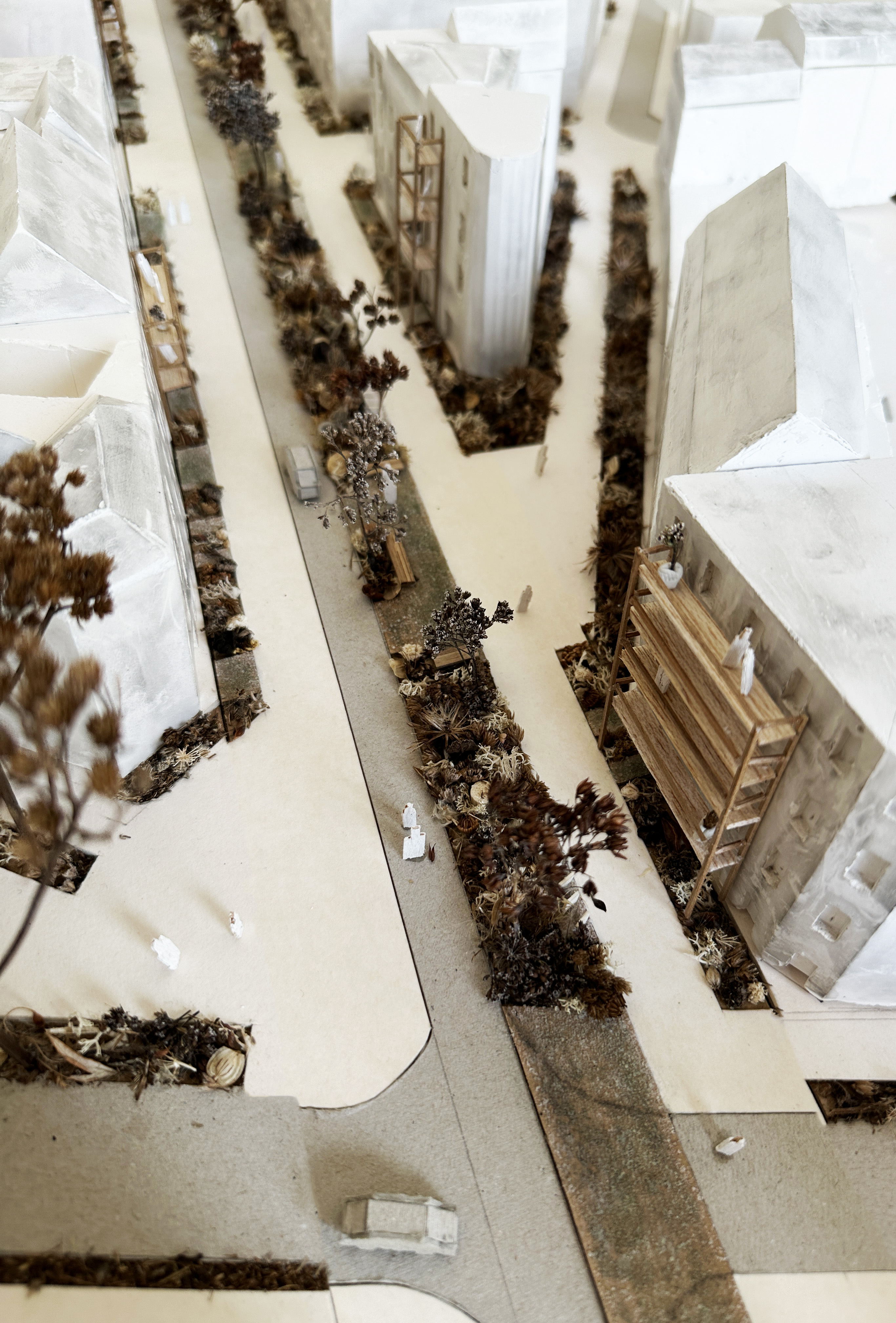
This sharing of the street contributes to its overall calming as well as to reducing negative effects such as heat islands, pollution, and more. Some small adjacent streets will become pedestrian-only, allowing the main street to expand. Thus, small squares will appear and can be appropriated by the users. To further involve the residents, a frontage zone will be offered to them. These frontages, whether dedicated to biodiversity or used for welcoming, storage, or privacy, will give the street a new identity.
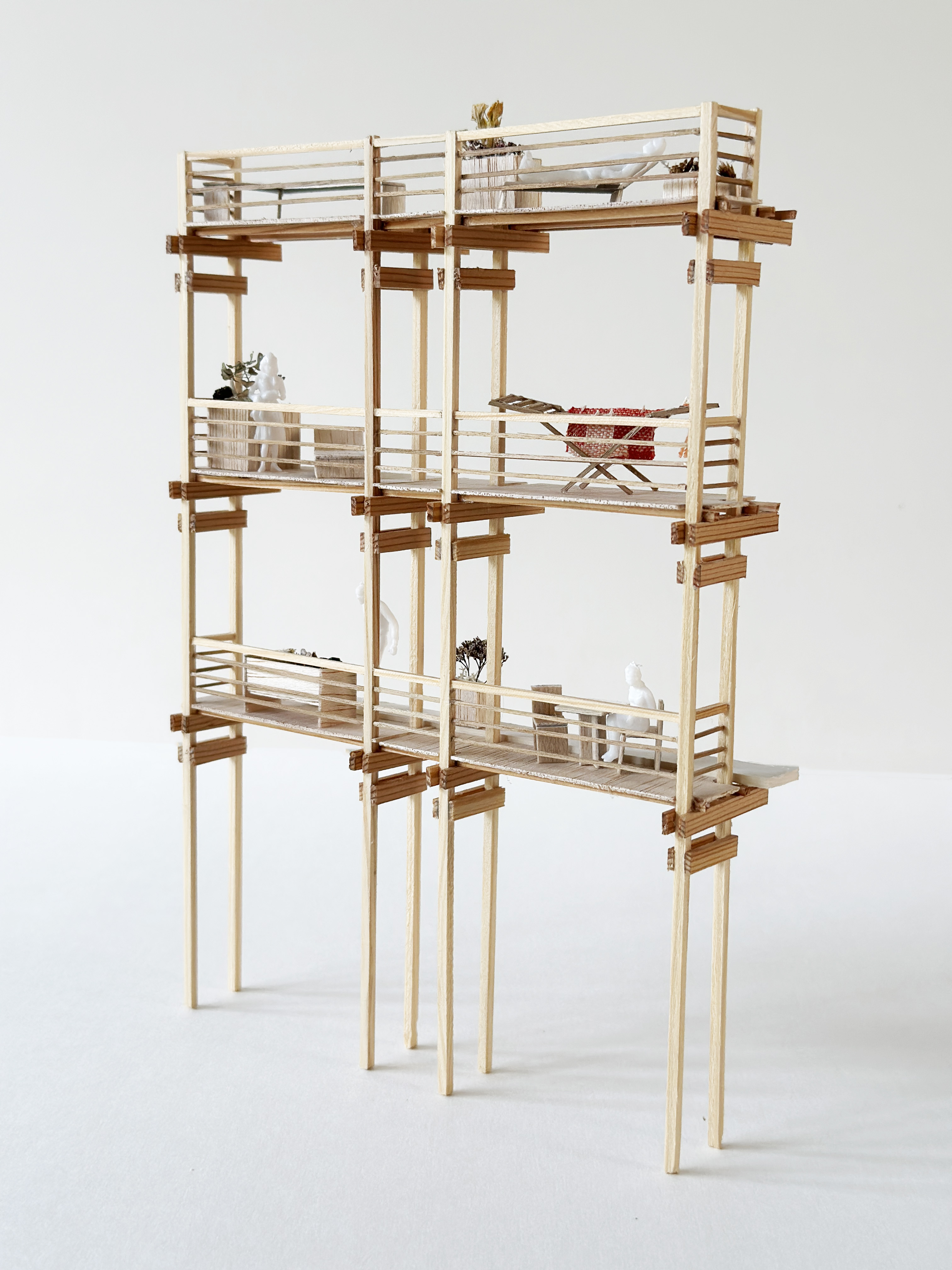
Additionally, structures will be added to the façades to serve as supports for climbing vegetation, habitats for certain animal species, and blank canvases for the residents. In this new street, movement is free, safer, and mainly achieved through soft mobility (bicycles, walking, cargo bikes, etc.). Residents reconnect with the surrounding biodiversity, gaining both well-being and space. Merchants benefit from a more pleasant outdoor space, while biodiversity thrives and moves freely thanks to partial soil permeability.
Propagation to the adjacent small streets
Seeking a balance among all street users
Providing an outdoor space that residents can appropriate

Projection of the street at a moderate ecological level
In 15 years, Solférino Street
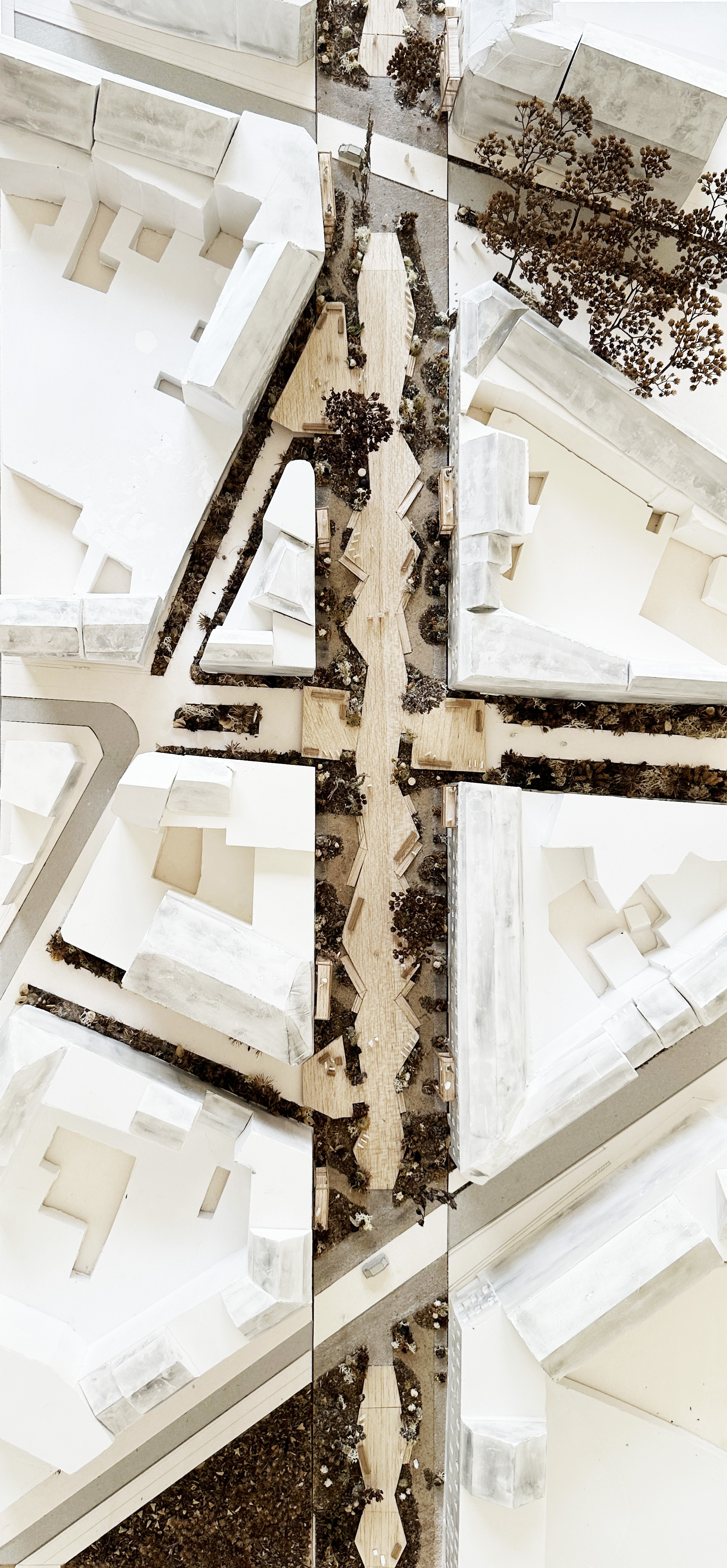
Scale model 1:200 of a section of the street with the high level"
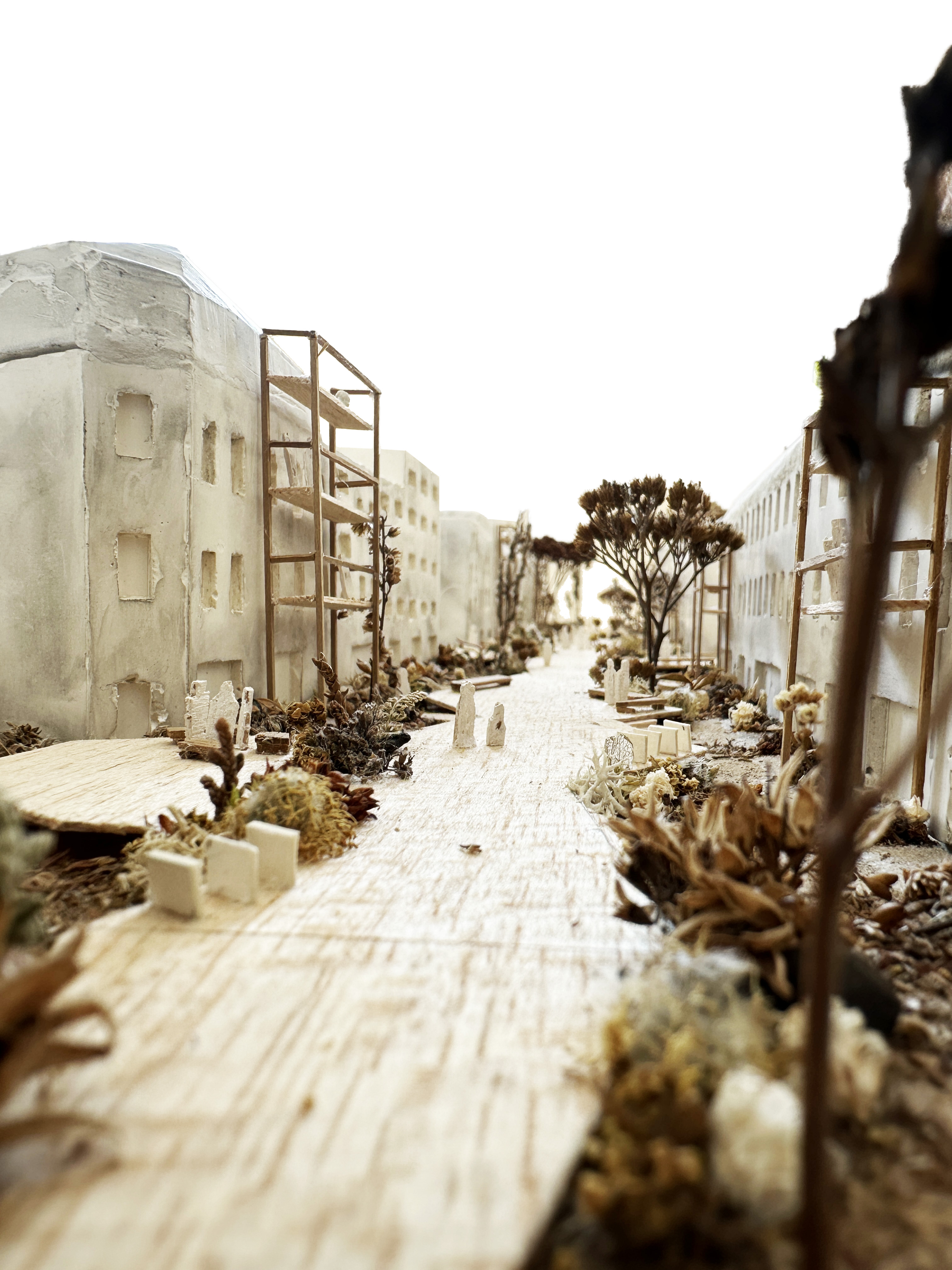
This level requires a profound overhaul of our lifestyles and ways of conceiving the world. Here, local food will be proposed, favoring short circuits and avoiding the use of pesticides. Special attention will be paid to rainwater harvesting, which will be stored for household use or watering the vegetable gardens. Low-tech solutions will be prioritized to limit energy consumption: washing machines, solar ovens, etc.
We will think more about reuse, repair, or recycling, rather than disposal. We will also think about building with geosourced materials, in a sustainable and thoughtful manner. This new organization, with the help of plants, effectively combats heat islands and the stress of street users. Pollution of all types (light, atmospheric, visual, etc.) is also significantly reduced. In sum, it is about taking a completely different approach from current lifestyles to design a street, a city, a world, that is more resilient.
This high level of ecological corridor is conceived with the idea of returning the essential spaces previously used by humans to biodiversity. Here, the soils are entirely permeable, allowing the water cycle to resume its course. A place is offered to each species. Humans retain the spaces offered in the previous level of action, namely, the structures and frontage bands. They also gain a pedestrian or soft mobility circulation space, represented by the central boardwalk. Around it, a public garden is accessible to passersby, with paths created within. By strolling through these gardens, humans reconnect with the rest of biodiversity and can even interact with it.
Here, the almost entire width of the street is then returned to biodiversity. Local animal and plant species are free to take their place there without any human pressure.
A 2km-long garden street
Explore other ways of living in the city

Projection of the street at a high ecological level